Welcome. I am Dr. Teyuna Darris, a communication scholar and certified educator dedicated to the power of the spoken and written word.
My work explores how we communicate identity, history, and values in a rapidly evolving world. From designing standards-based curriculum to researching the digital practices of the modern family, I am committed to giving people the language they need to own their stories.
Areas of Focus:
Communication Research: Analyzing family dynamics in the digital age.
Curriculum Design: Creating culturally responsive tools for K-8 education.
Narrative Stewardship: Curating literature that connects past and present.
Using visual rhetoric and material culture analysis, I treat the portrait’s pose, styling, and studio stamp as a single communication system—an argument made in paper, light, and ink (Foss, 2004)
The Artifact
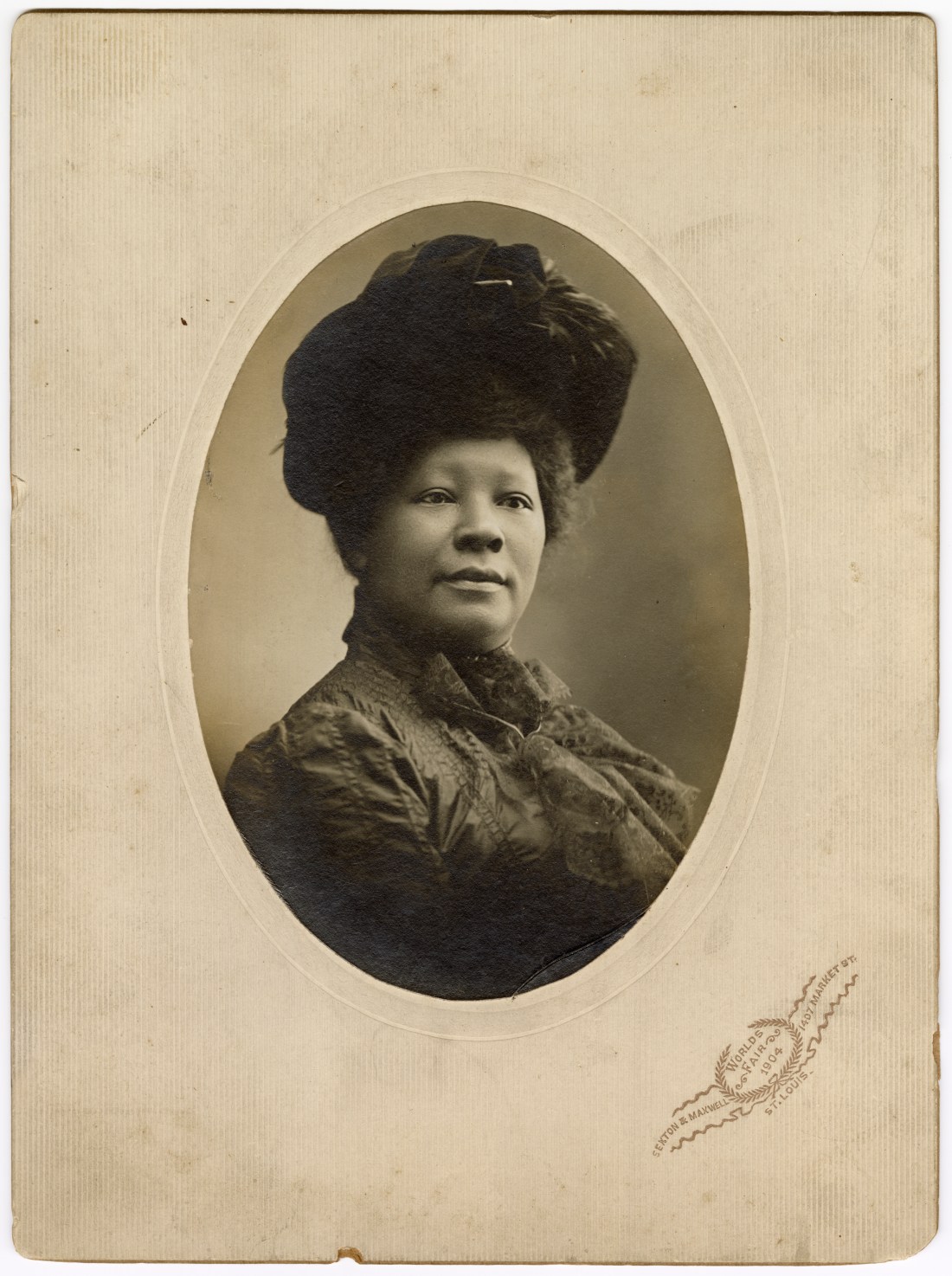
This is a vertical, black-and-white studio portrait of an African American woman, mounted as an oval photograph pasted onto a mat. The Missouri Historical Society describes her as “middle-class,” noting a lace bow at her neck and a hat (Missouri Historical Society, n.d.). The portrait’s physical construction matters because the mount is not a neutral background—it is part of the message. It is the frame that turns an image into a circulating object.
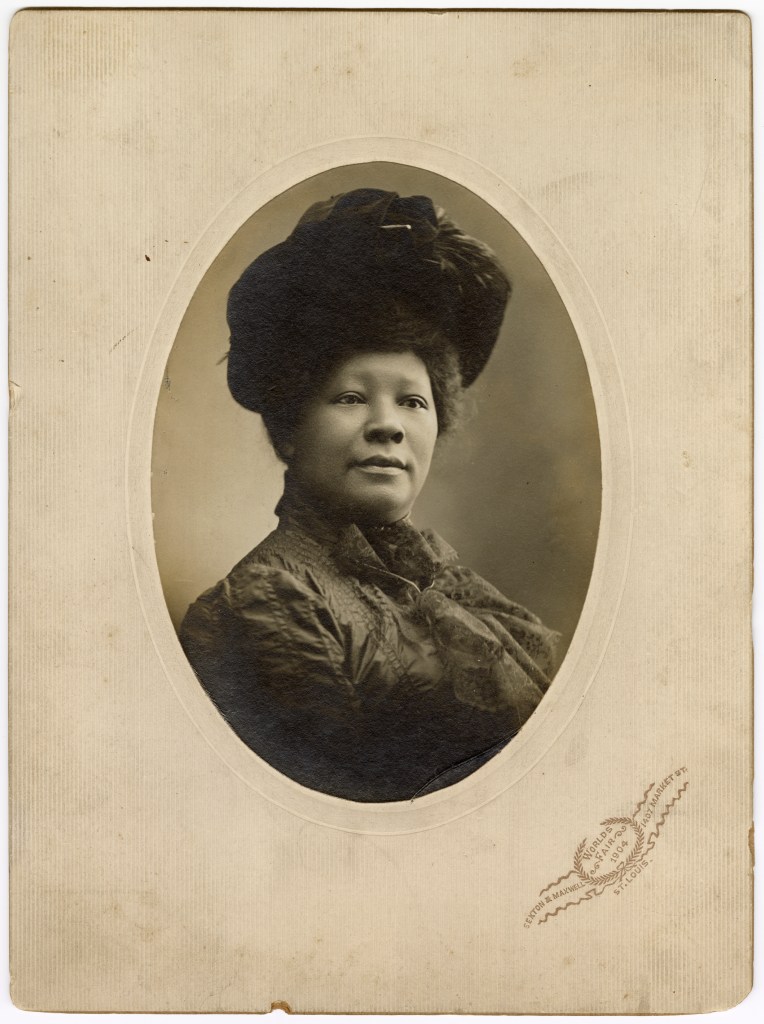
Unidentified African American woman, studio portrait (St. Louis, 1904). Mat stamp: “World’s Fair, 1904 / Sexton & Maxwell / 1407 Market St. / St. Louis.” Missouri Historical Society (African American Collecting Initiative), P1024-00009.
The Hook
The stamp is the receipt
In the lower-right corner, the studio stamp reads: “World’s Fair, 1904 / Sexton and Maxwell / 1407 Market St. / St. Louis.” (Missouri Historical Society, n.d.)
This is not decorative branding. It is evidence—proof of commercial participation in the Fair year. If the dominant myth treats African Americans as absent from the Fair-era economy, the stamp corrects the story with one blunt fact: someone commissioned this portrait, paid for it, and left with a finished product stamped for downtown circulation (Missouri Historical Society, n.d.).
Geospatial Anchoring
Why 1407 Market Street matters
The address 1407 Market St. pins this portrait to the city’s central corridor. Market Street is not a “side street” of history. It is civic St. Louis. City Hall is located at 1200 Market Street, placing this studio address inside the downtown institutional ecosystem, not outside it (City of St. Louis, n.d.).
That location matters for interpretation: the portrait isn’t simply “from St. Louis.” It is from the public spine of St. Louis, where commerce, government, and modern self-presentation converge.
Theoretical Framework
Why this portrait “argues”
1) Visual Rhetoric (Foss): Images function as rhetorical artifacts. They make claims, shape perception, and invite the viewer into an interpretation that feels natural—even when it is strategically produced (Foss, 2004).
2) Encoding/Decoding (Hall): Meaning does not sit inside the image like a label. Meaning is produced through choices (encoding) and then interpreted through audiences and contexts (decoding)—often in dominant, negotiated, or oppositional ways (Hall, 1980).
3) Archival Silence (Trouillot): The “unidentified” label is not a trivial gap; it signals how power shapes what becomes documented, searchable, and narratable. Archives preserve some parts of human life while muting others (Trouillot, 1995).
4) Narrative Identity (Somers): Identity is constituted through narrative placement—through social networks and the stories that tie people to institutions, places, and public life. Portraiture is one way people place themselves into those networks (Somers, 1994).
Materiality and Medium
Early 1900s “social media,” but make it paper
The portrait is mounted and branded—built for circulation. Long before digital platforms, studio portraiture created an offline infrastructure for identity: photos were displayed, carried, mailed, and collected. The mount’s function parallels what the cabinet card format normalized—photographic prints mounted on card stock with studio information designed to travel with the image (Society of American Archivists, n.d.).
I’m not claiming this object is literally a cabinet card; I’m saying it follows the same communicative logic: the photograph is inseparable from its designed portability and its commercial imprint (Society of American Archivists, n.d.).
Context
The Fair as a media machine—and the need for counter-messages
World’s fairs were not merely “events.” They were mass communication systems—staging progress, hierarchy, and belonging through spectacle and display. The Missouri Historical Society’s own educational materials document how the 1904 Olympics included “Anthropology Days,” framing “primitive peoples” and “primitive sports” in ways that reinforced racial hierarchy (Missouri Historical Society, n.d.-b).
That context matters because the stamp explicitly ties this portrait to the Fair year. Yet the woman in this photograph is not positioned as a display object. She appears as a client—someone using modern technology to author her own image.
Related viewing: The Fair as media environment (MHS video)
If you want to feel the Fair’s scale—the official story St. Louis was selling—watch this first. Then come back to the portrait.
Related context (MHS): A visual overview of the 1904 World’s Fair as a mass media environment—useful background for reading Market Street studio portraiture as counter-representation.
Decoding the Visual Media
1) Attire as message: the lace bow and structured hat
MHS notes the lace bow and hat (Missouri Historical Society, n.d.). These features operate as visual codes—what Hall would call part of the encoding process. Lace is precision. It communicates care, attention, and social literacy. The hat is structure—an engineered silhouette that expands her presence in the frame.
Read through Foss’s lens, attire here is not fashion trivia. It is rhetorical design: a curated public self, composed for circulation (Foss, 2004). In a media environment that routinely distorted Black identity, her styling communicates a refusal to be reduced.
2) Pose and gaze: refusing the “specimen” camera
She is posed in a three-quarter orientation with a calm gaze—neither hidden nor offered up for inspection. In a period when public institutions often framed non-white persons through hierarchy, this pose functions as a rebuttal. It says: I am not evidence. I am a person.
That is not sentiment; it is communication structure. She is encoding dignity into the portrait with the expectation that multiple audiences—family, peers, community—will decode it inside their own social world (Hall, 1980).
3) The stamp as a four-line counter-narrative
The stamp does two jobs at once:
Temporal anchoring: “World’s Fair, 1904”
Economic anchoring: “Sexton and Maxwell / 1407 Market St. / St. Louis.” (Missouri Historical Society, n.d.)
It’s the clearest proof-point in the entire artifact: Black presence is not only cultural; it is commercial, geographic, and modern—operating in the center lanes of the city.
Newspaper ad reading “Sexton & Maxwell, First-class Photographers, 1407 Market St.” SOURCE: Library of Congress, 2026
Sociology of the Subject
What we can say—and what we will not pretend to know
We do not have her name. The archive records her as “unidentified” (Missouri Historical Society, n.d.). That fact sets a boundary: we do not invent biography. But we can interpret what the portrait does socially.
First, the archive’s “middle-class” description is consistent with the portrait’s self-presentation—grooming, styling, studio setting, and commissioned mount (Missouri Historical Society, n.d.). Second, this portrait functions as a node in a social network: it is designed to move through relationships, anchoring identity in community recognition (Somers, 1994).
And third, the geospatial stamp places her within downtown civic life. When a woman can enter a Market Street studio in 1904, commission a portrait, and walk out with a stamped object meant to circulate, she is not outside modernity. She is participating in it.
Archival Silence
“Unknown” is not neutral
Trouillot’s argument is not that archives “lie.” It’s that power shapes what becomes preserved, described, and retrievable as history (Trouillot, 1995). This woman’s face survives; her name does not. That is a historically produced silence, not a personal absence.
So the task is not to fill the gap with imagination. The task is to speak clearly about what the archive already proves:
She existed. She chose. She paid. She circulated an authored image of herself—during the Fair year—on Market Street. (Missouri Historical Society, n.d.; City of St. Louis, n.d.)
Conclusion
The 1904 World’s Fair communicated hierarchy through spectacle. This portrait communicates something else: self-definition inside the city’s economy. The lace bow and structured hat are not only style; they are coded claims. The pose is not merely flattering; it is composure with purpose. And the stamp is the indispensable caption written by commerce itself:
“World’s Fair, 1904 / Sexton & Maxwell / 1407 Market St. / St. Louis.” (Missouri Historical Society, n.d.)
She remains unidentified by name—but her message is legible:
I am here. I am part of this city. I author my image.
Somers, M. R. (1994). The narrative constitution of identity: A relational and network approach. Theory and Society, 23(4), 605-649. https://www.jstor.org/stable/658090
As a Communication Scholar, I often look at how systems work—how messages are sent, how platforms are built, and how identity is constructed. While much of the world focuses on “posting” and “content,” 2025 for me was a year of strategic silence. It was a year of reading, thinking, and building the infrastructure for what comes next.
The Great Convergence: Building Stanza & Story The most significant professional undertaking of the year was a structural one. I spent months merging my previous projects—Good Poetry and Good Literature—into a single, cohesive media entity: Stanza & Story.
This wasn’t just a website update; it was a branding and communication strategy. I needed a centralized home that could house not just text, but the broader spectrum of cultural media I am researching. By consolidating these platforms, I created a more robust digital infrastructure capable of supporting the audio, video, and curriculum work planned for the future.
Research as Observation While I wasn’t hitting “publish” frequently this year, I was deeply engaged in the work of a media researcher: observation. My work involves looking at the artifacts of our shared history—old photographs, letters, and even cultural staples like food—and analyzing them through a communication lens.
I don’t just look at a historical photo to see who is in it; I look at how they are posed. What does their posture tell us about their agency? What story were they trying to tell about their family unit? I apply this same lens to cultural traditions—like the history of cornbread—analyzing them not just as recipes, but as vehicles for cultural transmission. This year was dedicated to gathering these insights and developing the frameworks to discuss them.
From Classroom to Concept My background as a Licensed Educator (CPC) and curriculum writer also played a vital role this year. The principles of instructional design—scaffolding information, engaging an audience, and clear messaging—are the same principles required to build a media company. I spent 2025 applying these educational strategies to my own business development, ensuring that when Stanza & Story fully activates, it does so with a clear pedagogical and communicative purpose.
Looking to 2026 If 2025 was the year of planning and merging, 2026 is the year of execution. The digital foundation is laid. The research frameworks are set. Now, the work shifts from the quiet phase of development to the active phase of production.



 Dr. Teyuna Darris